

AI MVP Development: How Startups Validate AI Products Faster
Learn how startups build and validate AI MVPs faster using modern AI infrastructure and LLM technologies.
September 1, 2026
•
6
min read

Spring’s AI news 2026 made the direction obvious: AI is entering the execution layer of software. And the next big breakthroughs to watch are happening across infrastructure, orchestration, safety, and developer tooling as much as they are within the actual models.
The model layer is now competing on context handling, repo-scale reasoning, latency economics, permission-aware tool use, and how well the model survives real workflows without constant human patching.
The biggest OpenAI news came on April 23, 2026, when OpenAI introduced GPT-5.5, with API availability following on April 24. OpenAI positioned it as a model for complex work, including coding, research, data analysis, document-heavy workflows, and computer-use tasks. The API version lists a 1M context window, with pricing at $5 per 1M input tokens and $30 per 1M output tokens, while GPT-5.5 Pro is priced higher for accuracy-sensitive workloads.
The coding angle is the most relevant for developers. OpenAI says GPT-5.5 performs better inside Codex-style environments where the model has to hold context across large systems, reason through ambiguous failures, check assumptions with tools, and carry changes through a surrounding codebase.

Source: https://www.windowscentral.com/artificial-intelligence/openai-chatgpt/openai-confirms-major-data-breach-exposing-users-names-email-addresses-and-more-transparency-is-important-to-us
On May 5, 2026, OpenAI rolled out GPT-5.5 Instant as the new default ChatGPT model. The interesting part is factuality and routing: OpenAI says Instant produces 52.5% fewer hallucinated claims than GPT-5.3 Instant on high-stakes prompts and improves image analysis, STEM answers, and decisions about when to use web search. That makes it less of a frontier-coding release and more of a default-model reliability update.
The strangest Anthropic Claude release was Claude Mythos Preview, announced with Project Glasswing on April 7, 2026. Anthropic called it its “most capable model yet,” but the rollout was not public API access. It was a gated cyber-defense program for organizations responsible for critical software infrastructure. Launch partners included AWS, Apple, Broadcom, Cisco, CrowdStrike, Google, JPMorganChase, the Linux Foundation, Microsoft, NVIDIA, and Palo Alto Networks.
The technical reason is obvious: Mythos-class capability collapses the boundary between defensive scanning and offensive exploitation. Anthropic says Project Glasswing is focused on finding and fixing vulnerabilities in foundational systems, and Reuters reported that Anthropic was extending access to around 40 additional organizations, with up to $100M in usage credits and $4M in donations to open-source security groups.
On April 1, 2026, Google shipped Gemma 4, its most capable open model family to date. While Google Gemini remains the closed frontier line, Gemma 4 is the release developers can actually inspect, fine-tune, deploy locally, and build around without turning every request into a hosted API call. The important piece is deployment spread. Gemma 4 covers larger cloud or single-GPU use cases and smaller edge/on-device variants.
Z.ai/Zhipu AI released GLM-5.1 in April under the MIT license, making it one of the most permissive major model releases of the season. Z.ai describes it as a model for “agentic engineering,” with stronger coding capabilities than GLM-5. The developer docs report 58.4 on SWE-Bench Pro, ahead of GPT-5.4, Claude Opus 4.6, and Gemini 3.1 Pro on that benchmark.
The practical tradeoff is still infrastructure. A large MoE model is not free just because the weights are open. Teams still need serving capacity, routing, quantization, monitoring, security review, and cost controls. But for engineering-heavy use cases, GLM-5.1 proves that serious coding performance is no longer locked behind one or two closed APIs.
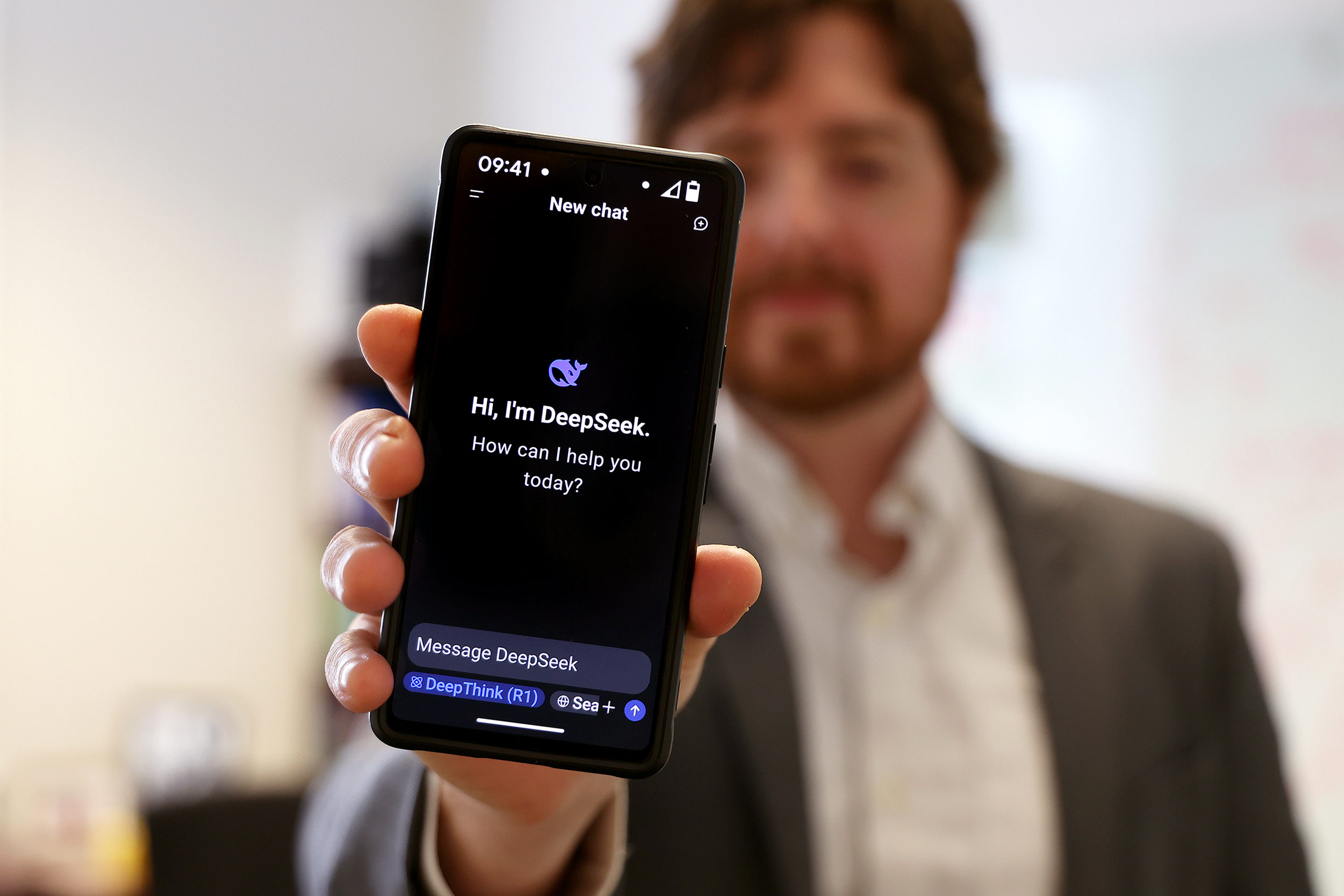
DeepSeek released a V4 preview on April 24, 2026, continuing the open-source pressure that started with its earlier R1 shock. The preview is positioned around agent tasks, knowledge processing, inference, and lower operating costs. CNBC reported that the model ships in “pro” and “flash” versions and is optimized for agent tools such as Claude Code and OpenClaw.

Source: https://news.darden.virginia.edu/2025/01/29/qa-what-is-deepseek-the-bargain-ai-roiling-the-stock-market/
The DeepSeek story in spring 2026 is more about normalization. That matters for anyone doing model procurement because the pricing floor keeps moving downward while capability keeps moving upward.
Rather than being required to infer something, model providers want to be given more control of the implementation. API is still the product surface, but the actual revenue is much more deeply rooted in the stack, and that is one of the biggest enterprise AI trends in 2026.
Anthropic made that vision explicit on May 4, 2026, when announcing its new enterprise AI services company in a public statement. Now the strategy is to use it as its platform to help medium-sized companies start bringing Claude back into their core functions. Anthropic also aims to help mid-sized groups integrate Claude into their core operations with Anthropic applied AI engineers to operate directly with the new firm’s engineering team on use-case discovery, custom systems, and long-term support.

Source: https://aragonresearch.com/anthropic-enters-life-sciences/
OpenAI followed with a bolder enterprise push. On May 11, 2026, Reuters said the company OpenAI Deployment (which it is investing over $4 billion in itself) had been created. The new unit is acquiring Tomoro, an AI consulting firm with about 150 AI engineers and deployment specialists, and it is designed around embedding specialists into organizations to identify and ship high-impact AI deployments.
IBM’s version of the same idea was pushed from a different angle at Think 2026 on May 5. Rather than framing AI as separate productivity capabilities, IBM positioned enterprise adoption within an “AI operating model” comprised of agents, connected data, automation, and hybrid infrastructure. Its big announcements, including the next-generation watsonx Orchestrate for multi-agent orchestration and more stringent governance and sovereignty controls for scaling AI, were also noted.
Spring 2026 turned AI regulation into a product-planning issue. The biggest move came from the EU. On May 7, 2026, EU lawmakers reached a provisional deal on the AI Omnibus, a simplification package that amends the implementation path of the EU AI Act. The headline change is timing: high-risk AI obligations are being pushed back from the original August 2, 2026 deadline. High-risk systems involving areas such as biometrics, critical infrastructure, education, employment, law enforcement, and border management now move to December 2, 2027, while AI systems embedded in regulated products get until August 2, 2028.
That delay matters for AI startups selling into Europe. It gives teams more time to align with standards, documentation, risk management, conformity assessment, and post-market monitoring expectations. It does not remove the compliance work, though. It just makes the roadmap less absurd for companies that were expected to meet high-risk obligations before all supporting standards were ready.
The AI Omnibus also adds a ban on so-called “nudifier” apps and AI systems that generate child sexual abuse material or non-consensual intimate imagery. The European Parliament says the ban is part of the new agreement, while Reuters reports enforcement is expected from December 2, 2026.

Source: https://www.linkedin.com/pulse/ai-regulation-governments-husam-yaghi-ph-d-9cale
The more technical change is around sensitive personal data. The AI Omnibus expands the ability to process sensitive data for bias detection and correction, under safeguards.
The UK is taking a different path. Its early-2026 signal is still sector-led regulation rather than one horizontal AI law. Existing regulators such as the ICO, FCA, MHRA, CMA, and Ofcom remain central, while the government leans on sandboxes, guidance, assurance tools, and growth infrastructure.
The U.S. picture is more fragmented and political. Executive Order 14365, signed on December 11, 2025, pushed for a national AI policy framework and raised the issue of state-level AI laws, including preemption questions. At the same time, states are still moving on their own. California, for example, signed a March 2026 order requiring AI safety rules for companies seeking state contracts, including safeguards around harmful bias, synthetic sexual content, unlawful discrimination, surveillance, and watermarking.
That makes U.S. AI regulation one of the messiest latest AI updates for engineering teams. Federal policy is leaning toward uniformity and acceleration, while state governments are building their own controls around privacy, biometrics, children’s safety, discrimination, procurement, and synthetic media. For companies shipping nationwide AI products, the risk is a patchwork of state obligations that affect logging, notices, model evaluation, data use, and customer contracts differently across markets.
The spring funding cycle made the AI market look less like a general-purpose model race and more like a stack-by-stack land grab. Cybersecurity is the cleanest example. On May 11, 2026, Israeli startup Frame Security came out of stealth with a $50 million round led by Index Ventures, Team8, and Picture Capital. The company is building a human-risk security platform for AI-powered social engineering, phishing, impersonation, and deepfake attacks.
Robotics also moved closer to public-market packaging. On May 11, 2026, RoboStrategy began trading on Nasdaq under the ticker BOT, giving investors exposure to robotics and physical AI companies through a closed-end fund structure. The portfolio is focused on automation systems, humanoid robots, and physical AI, with names such as Figure AI, Apptronik, Standard Bots, and Dexmate listed in the fund’s materials.
China’s AI funding race is getting more strategic. DeepSeek is reportedly in talks to raise capital at a valuation around $45 billion to $50 billion, with China’s state-backed semiconductor and AI funds involved. Reuters reported that the company could raise between $3 billion and $4 billion, while other reports point to a much larger possible round.
Google is taking a different route with early-stage ecosystem capture. The Google for Startups Accelerator is targeting companies building core AI products, with support across Google Cloud, TPU access, Android, product design, growth, and early access to Google AI tools. The interesting part is the focus: agentic AI, multimodal products, and generative AI systems that can scale beyond demos. For Google, this is not charity; it is a way to pull promising AI startups into its cloud and model ecosystem early.
Source: https://inc42.com/buzz/google-india-launches-accelerator-program-for-women-led-startups/
Vertical AI is also absorbing more capital. Gallagher Re reported that AI-focused insurtech startups captured 95.2% of global insurtech funding in Q1 2026, raising $1.55 billion across 68 deals. Total insurtech funding reached $1.63 billion for the quarter, meaning almost the entire category is now being priced through an AI lens.
AI industry news shows that AI funding is getting more specific. Investors are still chasing model companies, but the stronger pattern is capital moving into applied layers where AI changes a sector’s cost structure or risk model.
Spring 2026 brought AI adoption down to more technical and less experimental levels. No longer has business opted for “the smartest model” alone; companies need to fit models to real workflows, latency limits, security needs, hosting strategy, compliance exposure, and failure tolerance.
OpenAI, Anthropic, Google, DeepSeek, GLM, and others are all pushing across the board of deployment pathways, from closed frontier models to open-weight systems and edge-ready inference. Enterprise AI is also transitioning from piloting to deployment. Model suppliers want greater control over services, integration, agents, and governance, as well as workflow design, which can accelerate adoption but also drive up vendor lock-in.
At the same time, regulation is building more of a block: EU AI Act changes, UK sector-led rules, and fragmented policy in the United States all mean that documentation, bias testing, monitoring, data controls, and auditability must come in early.
The business takeaway is straightforward: AI in 2026 is an architecture choice. Companies need clear use cases, clean data access, evaluation pipelines, permissioning, security controls, and a deployment model they can actually work with. The winners will be those teams that view AI as part of the execution layer of the business.
AI is moving fast, but business value still comes from execution. If you are building agentic workflows, modernizing internal systems, or planning an enterprise AI product, we can help translate market shifts into reliable software that works in production. Contact us today.


Lorem ipsum dolor sit amet, consectetur adipiscing elit. Suspendisse varius enim in eros elementum tristique. Duis cursus, mi quis viverra ornare, eros dolor interdum nulla, ut commodo diam libero vitae erat. Aenean faucibus nibh et justo cursus id rutrum lorem imperdiet. Nunc ut sem vitae risus tristique posuere. uis cursus, mi quis viverra ornare, eros dolor interdum nulla, ut commodo diam libero vitae erat. Aenean faucibus nibh et justo cursus id rutrum lorem imperdiet. Nunc ut sem vitae risus tristique posuere.
Reply