

AI Development
Private AI Systems for Enterprise Companies
Learn how enterprises build secure private AI infrastructure, self-hosted LLM systems, and compliant AI environments.
August 11, 2026
•
10
min read


No longer is AI for e-commerce confined to basic chatbots and product recommendations. Many online retailers now use AI across the entire operating spectrum: marketing, inventory planning, customer support, logistics, content production, and data analytics.
The reason for that largely is that e-commerce produces too much data for manual decision-making. AI transforms those signals (e.g., clicks, cart) into actions that take place faster.
Rather than entirely replacing human teams, the vast majority of companies deploy AI as a processing layer. It performs repetitive analysis or first-line responses where humans review, make corrections, and make final decisions. This makes for a pragmatic human-in-the-loop model: AI prepares the output, then the team polishes it.

Source: https://business.olx.ua/statti/ecommerce-pro-riznovydy-ta-funktsiyi/
Also, the extent to which the company size and the technological maturity of a firm determine AI adoption. Many small e-commerce businesses on low-end online store platforms use platform-native tools. They tend to rely on built-in recommendation engines, ad automation systems, or chatbot plugins as part of their platform-native tools. The mainstay is third-party AI tools combined with custom workflows by mid-sized companies. Bigger retailers could construct AI systems on their own, integrating directly with ERP, CRM, warehouse, analytics platforms, and other systems.
This is why e-commerce automation AI implementation is not cookie-cutter. Some companies require elementary automation on Shopify, WooCommerce, or marketplace platforms. Others require bespoke AI infrastructure, including data pipelines, model orchestration, API integrations, and monitoring.
E-commerce AI solutions work best when they are connected to real operational data. The value does not come from adding “AI” as a standalone feature. It comes from embedding models into workflows where decisions are made every day.
For instance, AI demand forecasting is used by e-commerce teams to determine exactly how much stock they'll need for each SKU, category, location, or sales channel.
Let’s say, a fashion retailer could predict higher demand for particular sizes, colors, or categories before a seasonal campaign ever goes live. A grocery delivery platform can foresee demand for perishable goods and minimize waste. A marketplace can tell which products are susceptible to a spike, based on search volume and cart activity before anything is bought.
Its chief commercial value is straightforward: fewer stockouts, less dead inventory, and improved cash flow.
So the thing that turns forecasting into actions is replenishment. The model advises when to reorder, how much to reorder and which supplier or warehouse should be responsible for the next movement of stock.
In practice, AI can flag SKUs that are close to stockout, suggest reorder quantities, prioritize fast-moving products, and reduce over-ordering for slow-moving items. For the larger e-commerce companies, it can be interfaced with ERP, WMS, or supplier systems directly using APIs.
This is especially useful for brands with large catalogs. Once a store has thousands of SKUs, manual replenishment becomes slow, reactive, and error-prone.
AI support in e-commerce is progressing from simple FAQ bots. Modern systems can also interface with order management systems, return policies, delivery providers, CRM records, and product databases. This gives the assistant a chance to give answers to queries that include “Where is my order?”, “Can I return this item?”, “Which size should I choose?”, or “Why was my payment declined?”

Source: https://www.morphcast.com/blog/emotion-ai-in-customer-support/
That said, the execution isn’t 100 percent self-contained from day one. And most e-commerce operations begin with AI-assisted client support, in which a system creates replies, classifies tickets, summarizes customer history, and offers suggestions for next steps. Human agents continue to help with edge cases or refunds, and high-value customers. This eases the ticket load while maintaining control over customer experience.
Product recommendations using AI are by far the most powerful e-commerce use case because they directly impact conversions. Recommendation models analyze the behavior of customers and patterns to determine what each shopper should see next. There are several well-known methodologies.
This powers blocks such as “Recommended for you,” “Frequently bought together,” “You may also like,” “Complete the look,” and personalized homepage sorting. More sophisticated systems further personalize email campaigns, push notifications, search results, product bundles, and discounts.
Amazon is the archetypal example here for this. Its recommendation engine has been benchmarked in the personalization landscape of e-commerce for a while, with product recommendations tied to a substantial slice of buyers’ purchases. McKinsey reported that 35% of Amazon purchases came from recommendation algorithms.
In the case of small e-commerce companies, the same could be realized using recommendation APIs, platform plugins, or custom ML models linked to a product catalog.
Important takeaway: AI product recommendations shouldn’t be limited to displaying popular items. It has predictive ability regarding user intent in the current context.
Fraud detection is yet another high-impact AI use case because e-commerce fraud continues to grow along with online sales. Retailers, marketplaces, and payment providers already use AI-driven fraud prevention systems to reduce chargebacks, identify suspicious transactions, and protect customer accounts.
Its impact on business is widely documented. Mastercard has also announced that AI-based fraud detection can enhance fraud detection rates by 20%, and, in some instances, by several hundred percent, over legacy methods.
The benefit extends beyond stopping fraud. Better detection lessens chargeback costs, lessens manual review load, safeguards customer trust, and makes it easier for legitimate orders to move through the checkout process. It is important during peak business times (such as prime shopping seasons), as transaction volumes have grown alongside fraud attempts.
Because online businesses are growing, the ability to spot fraud much quicker without creating real pain points for customers is a big one, and artificial intelligence is already delivering one of the most powerful solutions to the challenge.
AI search enhances customer searches for products without knowing the actual product name. When users type vague queries, traditional keyword search is often useless. For instance, a customer might search for “black dress for wedding guest" or “gift for a 10-year-old who likes science.”
Modern AI-based search systems, on the other hand, know how icontext work and can comprehend intent accordingly, making it much easier to find the product. AI search can make sense of these requests, relate them to product attributes, filter the catalog, and rank results by relevance, availability, popularity, margin, or user profile.
Recent news from Google has reinforced the growing importance of conversational search. With AI-powered Search Generative Experience (SGE) and AI Overviews, Google is starting to help users ask sophisticated, multi-part, natural-language questions and get synthesized answers.
Source: https://www.cyber-duck.co.uk/insights/google-ai-overviews
It’s part of a larger trend in e-commerce: customers want search experiences that resemble a conversation rather than a database query. So, e-commerce brands, too, are building such capabilities into their own websites, where shoppers can refine search queries, ask follow-up questions, and receive more contextually enhanced product recommendations.
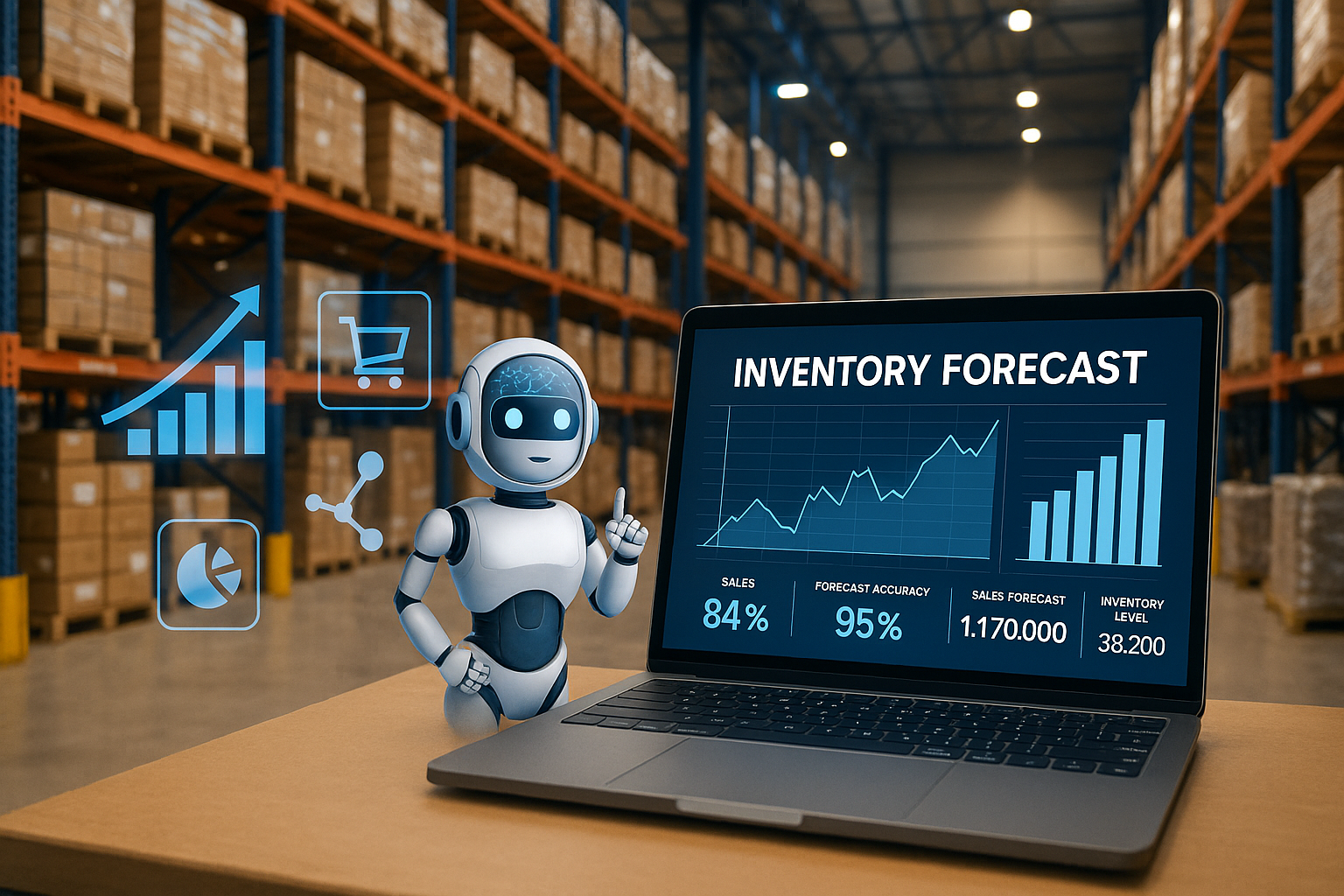
AI inventory forecasting is the process of predicting product demand and deciding which items to put into inventory, based on realized demand, using a machine learning model. Unlike traditional forecasting techniques, which base their predictions upon rigid rules or periodic updates, AI systems refine their predictions when new data becomes available.
Technically, forecasting begins with preparing data. Information collected from different sources is cleaned and standardized. This is important, since forecasting accuracy is heavily dependent on data quality.
Once the data has been formed, forecasting models can produce demand predictions at each level (single SKUs, product categories, sales channels, or warehouses, for example). Companies might take traditional time-series forecasting, machine learning algorithms, or deep learning models to see patterns in large product catalogs, depending on the size and complexity of the business.
AI prediction forecasting has a significant benefit: it generates multiple estimates on demand. Most modern systems create probability ranges, detect unusual demand trends, and signal potential forecasting risks. This helps inventory teams not only predict what’s expected to happen but also how confident the model is in its prediction.
Source: https://www.thetatechnolabs.com/blog-posts/agentic-ai-for-smart-inventory-forecasting-transforming-e-commerce-supply-chains-in-dallas
The prediction, in turn, helps to inform inventory planning processes. Demand predictions are assessed using current stock levels, supplier lead times, safety stock needs, and inventory replenishment plans. Utilizing those inputs, the system can suggest reorder quantities, warn about possible shortages, or spot excess inventory when it’s not yet too high.
AI customer support is one of the fastest-growing AI use cases in the e-commerce context because teams handle numerous repetitive requests at the same time, including order tracking, returns, refunds, product questions, and more.
Nowadays, modern AI assistants can answer these inquiries instantly (connecting to orders, policies, and product data with the most advanced AI), as well as guiding more complicated questions to the appropriate team of personnel. They automate processes and understand customer intent with the help of complex technologies, unlike a simple e-commerce AI chatbot that can only provide data from a simple list of chat messages.
Real-world findings explain why companies are investing more in this space. Lenovo, for example, found its AI-driven virtual assistant automated a significant proportion of customer inquiries across support channels, leading to less human intervention on standardized requests and faster responses.
Vodafone has also leveraged AI customer service software to manage millions of inquiries per year, to resolve more mundane customer queries more quickly while allowing CAs to concentrate on higher-frequency inquiries. These scenarios are part of a larger trend: companies are using AI to process everyday customer assistance requests, shorten response times, and free up human agents to handle more complex customer cases.
Salesforce says 95% of service decision-makers who are getting smart through AI experience cost and time savings, and 92% agree that generative AI allows them to give better customer service. Zendesk is also seeing surging customer expectations about first-response support, with more consumers looking for 24/7 and faster response times.
Recommendation systems assist the store in determining which products each user is most likely to pay attention to, click on, and make a purchase. The idea is simple: rather than showing everyone one list of products, the store customizes the shopping experience depending on customer behavior, product context, and purchasing intention.
A recommendation system begins with the learning from signals approach. Examples of these signals are viewed products, past purchases, cart additions, search queries, wishlists, skipped items, price range, size preferences, brand affinity, and category interest. Each action informs the system what the user might want next in response.
For instance, if a shopper spends much of their time looking at minimalist sneakers, adding neutral colors to a cart, and buying mid-priced casualwear, the store shouldn’t be displaying random bestsellers first. It should prioritize products that fit with the shopper’s taste, budget, and current session behavior.

Source: https://www.aboutamazon.com/news/retail/amazon-generative-ai-product-search-results-and-descriptions
Personalization also operates on the product level. After purchasing a particular smartphone, many customers purchase a phone case, and the system learns that these products are related. If shoppers who are buying running shoes also browse for sports socks and fitness watches, those two items can be described as “frequently bought together” or “complete your setup” recommendations.
This is why good personalization isn’t all about displaying popular products. Popularity is only one cue. A good recommendation system knows the difference between the current trend globally and the one relevant to a given customer at the time.
Another great e-commerce case of consideration is given to ASOS. The big fashion retailer provides personal product recommendations for customers along the way, guiding them to products compatible with their browsing activity, style tastes, and purchase histories. Recommendations appear on category pages, product pages, and marketing emails, enabling shoppers to more easily locate products in their category without searching through the entire catalog.
Netflix is another great example, although it is not e-commerce in the traditional sense. Its recommendation system shows the same principle at scale: when the platform reduces the effort to find something relevant, users stay engaged. According to McKinsey, 75% of how people watch content on Netflix is through recommendations, revealing how much personalized discovery can determine user behavior.
Stitch Fix applies personalization much more curately in fashion ecommerce. The company integrates customer preferences, purchase history, feedback, and stylist input to curate clothes to suit the fashion user’s tastes and body. The key is the human-in-the-loop model: the system picks and chooses relevant alternatives, and stylists add context that the data alone might not capture.
For e-commerce companies, personalization helps with product discovery, higher average order value, and decreased choice overload. Customers spend less time curating catalogs and more time making product decisions when they see relevant products faster.
AI automation in e-commerce works best when it is applied to repeatable operations that depend on data, rules, and fast decision-making. The goal is to reduce manual work and let teams focus on decisions that need human judgment.
We already covered the aspects that are mostly automated by AI right now. But the list still goes on. AI, for one, can also automate order management. It can detect delayed orders, identify fulfillment issues, update customers about shipping status, and route problematic orders to the right team. This is especially useful during peak sales periods, when manual tracking becomes slow and inconsistent.
AI can also automate parts of product catalog management. It can:
This is valuable for stores with large catalogs where manual updates take too much time.

Source: https://www.efulfillmentservice.com/2024/11/using-ai-for-product-personalization-how-ai-enhances-your-customer-experience/
Marketing operations can also benefit from AI automation. AI can segment customers, personalize email content, recommend products, generate campaign variations, analyze performance, and suggest when to pause or scale campaigns. It helps teams move faster without relying only on manual campaign reviews.
Continuing the marketing direction, AI can analyze demand, competitor pricing, inventory levels, margin, and customer behavior to recommend price changes or discount strategies. This directly influences pricing and promotions. For example, it can flag slow-moving products for promotion or protect high-demand products from unnecessary discounting.
AI integration with Shopify and Amazon usually happens in three ways: built-in platform tools, third-party apps, or custom systems connected through APIs. The right option depends on how much control the business needs.
The easiest entry point for Shopify stores is platform-native AI. The platform already features AI, in the form of Shopify Magic and Sidekick, which help merchants build product descriptions, generate store content, analyze store data, and speed up mundane administrative efforts. This is the simplest version of AI for Shopify because the tools work inside the existing environment and do not require a custom backend.
The next level is third-party AI apps. E-commerce teams connect chatbots, product recommendations, search, email personalization, review analysis, upselling, pricing, or inventory alerts all on apps. These tools typically interact with the Shopify shop, examine product and order data, and incorporate AI functions via widgets, dashboards, or automated workflows.
Where a store needs more control, custom AI integration is used. In this setup, Shopify plays the commerce layer role while the AI acts like a distinct service tied to store data.
Amazon operates differently because sellers are inside a marketplace environment. With less control over the commercial storefront, they can nevertheless use AI for making product listings better, more competitive pricing, more advertising materials, better inventory planning, analysis of reviews and customer service. Amazon also offers generative AI tools which help sellers create product listings from brief descriptions, images, or existing product URLs.
For deeper Amazon integration, you can go and use the Amazon Selling Partner API for larger integrations. It empowers approved systems to see marketplace information, including orders, shipments, inventory, reports, and payments. This data can be used by an AI system to identify changes in demand, make recommendations on stock actions, optimize product content, or track operational risks.
Source: https://www.retailbrew.com/stories/amazon-opens-its-ai-shopping-tech-for-business-with-retailers
For brands selling on both Shopify and Amazon, the best setup is usually a shared AI layer. Instead of treating each channel separately, the system collects data from both platforms and creates a unified view. This helps teams avoid disconnected decisions, such as overstocking one channel while another runs out of inventory.
When implemented in e-commerce with AI in the first place, it can do well, but it is not plug-and-play. The most common issue is data quality. If product information, order history, inventory information, or customer profiles are messy, the AI system gives weak suggestions and makes bad predictions.
Integration is also common. AI must have easy access to e-commerce platforms, CRM, ERP, warehouse systems, payment tools, and analytics data. In non-connected systems, it means little automation will be available, and teams are still needed to fix problems manually.
On the other hand, there is the issue of control. AI has the ability to produce product content, reply to support requests, suggest prices, or forecast demand, but businesses will still require human review for those critical decisions. Badly controlled AI can generate mistakes, bad discounts, useless recommendations, or customer frustration.
Cost is probably the most popular factor. A simple chatbot or a recommendation plugin is straightforward to implement, with custom AI systems needing data engineering, API integrations, monitoring, testing, and ongoing optimization. The best approach is to begin with a clear use case and a measure of its impact and only expand once we develop a workflow with proven value added.
The good news is that these challenges are predictable. We know where AI projects fail, how to avoid common implementation pitfalls, and how to build solutions that deliver measurable business value instead of becoming another unused software subscription.
Whether you want smarter inventory planning, AI-powered customer support, personalized shopping experiences, or end-to-end e-commerce automation, the right strategy matters as much as the technology itself.
If you're looking for AI for your shop, get in touch with QuantumCore. We'll help you identify the highest-impact opportunities and build/implement the right solution that delivers real business results!
Contact us today!
The best practice is a hybrid approach. AI should handle 80–90% of repetitive, high-volume queries (tracking, returns, product specs), but must have a seamless “handoff” protocol to escalate complex or emotional issues to human support agents immediately.
Modern systems use Retrieval-Augmented Generation (RAG). Instead of relying solely on the AI's "internal" knowledge, the system is programmed to look up answers only within your verified company knowledge base and product feeds.
Dynamic pricing uses AI to adjust product prices in real-time based on competitor pricing, current demand, and inventory levels. While it can maximize margins, the risk is a potential loss of customer trust if prices fluctuate too aggressively. Best practice involves setting "price floors" and "ceilings" to keep changes within a range that feels fair to the consumer.
Traditional security relies on rules (e.g., "deny if transaction > $1000"). AI looks for anomalous patterns, such as a user browsing from a specific location but checking out from an IP address halfway across the world, or purchasing behavior that deviates significantly from a user's historical profile. It identifies these threats in milliseconds.
Trying to "do it all." The most successful projects start with a single, high-impact use case (e.g., automating "Where is my order?" inquiries). Once that is perfected and the ROI is proven, you can layer on more complex features like hyper-personalized product recommendations.

Lorem ipsum dolor sit amet, consectetur adipiscing elit. Suspendisse varius enim in eros elementum tristique. Duis cursus, mi quis viverra ornare, eros dolor interdum nulla, ut commodo diam libero vitae erat. Aenean faucibus nibh et justo cursus id rutrum lorem imperdiet. Nunc ut sem vitae risus tristique posuere. uis cursus, mi quis viverra ornare, eros dolor interdum nulla, ut commodo diam libero vitae erat. Aenean faucibus nibh et justo cursus id rutrum lorem imperdiet. Nunc ut sem vitae risus tristique posuere.
Reply