

AI Development
AI Integration Services: Connecting LLMs with CRMs, ERPs, and Internal Systems
Learn how businesses integrate LLMs and AI systems with CRMs, ERPs, databases, and enterprise workflows.
July 23, 2026
•
8
min read
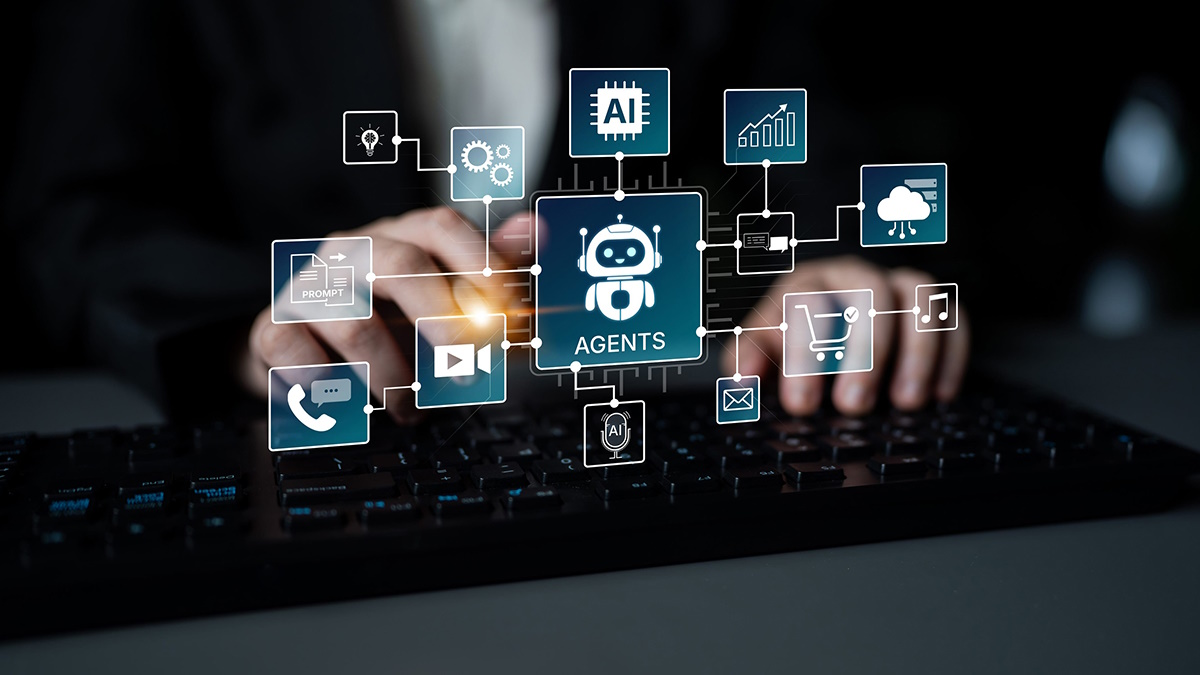

AI agents for business are coming across as the next obvious step for teams who have already squeezed as much value as they can out of basic automation. Surely, a chatbot can answer questions, but something better is possible than that at AI. It extracts customer data, updates a CRM, schedules meetings, sends out follow-ups, keeps workflows running 24/7, etc., without anyone on call (or hovering) to take care of it. AI agents can also help teams respond to market trends and automate mundane workloads. Already, some organizations are reporting cost savings of up to 37%.

Source: https://insidetelecom.com/autonomous-ai-agent-will-bring-better-reasoning-execution-to-generational-intelligence/
It’s remarkable how aggressively marketing teams are already leaning into AI. 51 percent optimize content with AI, 50 percent write content utilizing it, 45 percent brainstorm with it, 43 percent automate repetitive tasks, 41 percent analyze data and 73 percent say AI helps them create more personalized consumer experiences. But the real value starts when AI moves beyond isolated tools. And that is why we’ll be talking about AI agent development.
An AI agent is a software system that uses artificial intelligence to achieve a goal, to make decisions, and to perform tasks on behalf of a user or business process. Unlike a simple script that follows fixed rules, an agent can understand input, break a task into steps, choose which tools to use, and adapt based on context.
Today’s AI agents operate on large language models and are tied to external tools, APIs, databases, knowledge bases, or business software. This allows them to advance from natural language replies to real workflow execution. The difference is autonomy.
A chatbot talks, an AI agent does.
A chatbot answers FAQs, explains policies, recommends a product, or helps a user find information faster. But once the user says, “Okay, book it,” “update the record,” “send the follow-up,” or “check this against our internal data,” a basic chatbot usually hits the wall. It can describe the next step, but it cannot reliably execute the workflow unless someone connects it to business logic.
An AI agent is built for execution. It can understand the request, decide what needs to happen, call the right API, read or write data, trigger actions, and hand off edge cases to a human when confidence is low. That changes the business result completely. The value is fewer manual steps between intent and outcome.
This is also where many teams get disappointed with off-the-shelf AI tools. They expect agent-level value from chatbot-level architecture. Then they wonder why the system cannot handle context, remember previous actions, work across apps, or recover when something breaks. The problem is not the model. The problem is that answering and acting are two different engineering problems. If the goal is customer support content, a chatbot might be enough. If the goal is revenue ops, internal tooling, or multi-step decision-making, you are in AI workflow automation.
A language model often powers the agent's ability to understand requests and generate responses, but the model alone is not what makes an agent useful. In production environments, agents rely on several supporting components. A production AI agent typically includes:

Source: https://www.itweb.co.za/article/ai-agent-essentials-explained-skills-use-cases-competency-validation/kLgB17ezVjpM59N4
Together, these components allow an agent to move beyond conversation and perform real work.
The reasoning layer is the decision-making engine of the agent. When a request arrives, the agent first determines what needs to happen.
For example, if a user asks for a sales report, the agent may:
The important distinction is that the path is not always fixed. Traditional software follows predefined rules. An AI agent can adapt its approach based on many circumstances.
Advanced systems might incorporate planning and evaluation methods to enhance decisions. These may include loops of reflection, self-evaluation, iterative planning, or search-based approaches that help the agent choose the most effective sequence of actions.
Memory helps agents preserve knowledge beyond a single interaction. The majority of agent architectures categorize memory into short-term and long-term storage. Short-term memory helps the agent keep track of the current task. Long-term memory contains information that remains useful over time. This includes user preferences, historical interactions, company knowledge, workflow outcomes, or domain-specific information that the agent may need in future tasks.
To support memory, these systems often utilize vector databases, semantic search, knowledge graphs, and Retrieval-Augmented Generation (RAG). These tools help agents retrieve relevant information when needed instead of relying entirely on what has been learned during model training.
Tools are frequently defined as “things an agent can use,” which doesn’t capture why they are important. A tool provides an agent access to capabilities that do not exist inside the model itself. The model might reason about a spreadsheet, but it cannot open one. It can explain how to create a support ticket, but it cannot create the ticket unless it has access to the system where tickets live.
In practice, tools are executable functions exposed to the agent. A CRM lookup, a SQL query, a document parser, a code execution environment, an inventory search, or an email sender can be expressed as tools. The agent selects one based on the task, passes the required parameters, receives a result, and incorporates that result into its next decision.
APIs provide the connection between agents and business systems. Most integrations rely on REST APIs, GraphQL, webhooks, event-driven systems, or RPC frameworks.
In production environments, these integrations also require supporting infrastructure. Once connected through APIs, agents can begin executing real-world tasks.
AI orchestration is one of the least known aspects of agent architecture. Many see an agent as one model making everything from beginning to end. Production systems, actually, have multiple models, retrieval systems, tools, databases, queues, validation layers, and human approval steps. There’s got to be something that can coordinate all of that.

Source: https://www.mindstudio.ai/blog/ai-orchestration
So imagine a document-processing workflow. A PDF arrives through an upload portal. One service extracts text. Another classifies the document type. A retrieval system pulls relevant company policies. An LLM analyzes the content. The validation layer checks confidence scores. Output that hits predefined thresholds is written to a business system. Otherwise, it is sent to a human reviewer. However, none of those parts know how to run the entire process. It's only the orchestration layer that can handle all that.
AI orchestration manages state, execution order, retries, branching logic, dependency management, and failure recovery. It decides what happens when a tool fails, when a model returns low-confidence output, and when one of the processes calls for human approval before going on in a workflow.
The workflow defines the stages a task moves through, the conditions that must be satisfied before progressing, and the actions that occur when something goes wrong. The agent provides both judgment and flexibility within those boundaries.
This distinction matters because reasoning and workflows solve different problems. Reasoning helps the system figure out what to do when information is incomplete or ambiguous. Workflows ensure that critical business processes remain consistent regardless of how the agent reaches a decision.
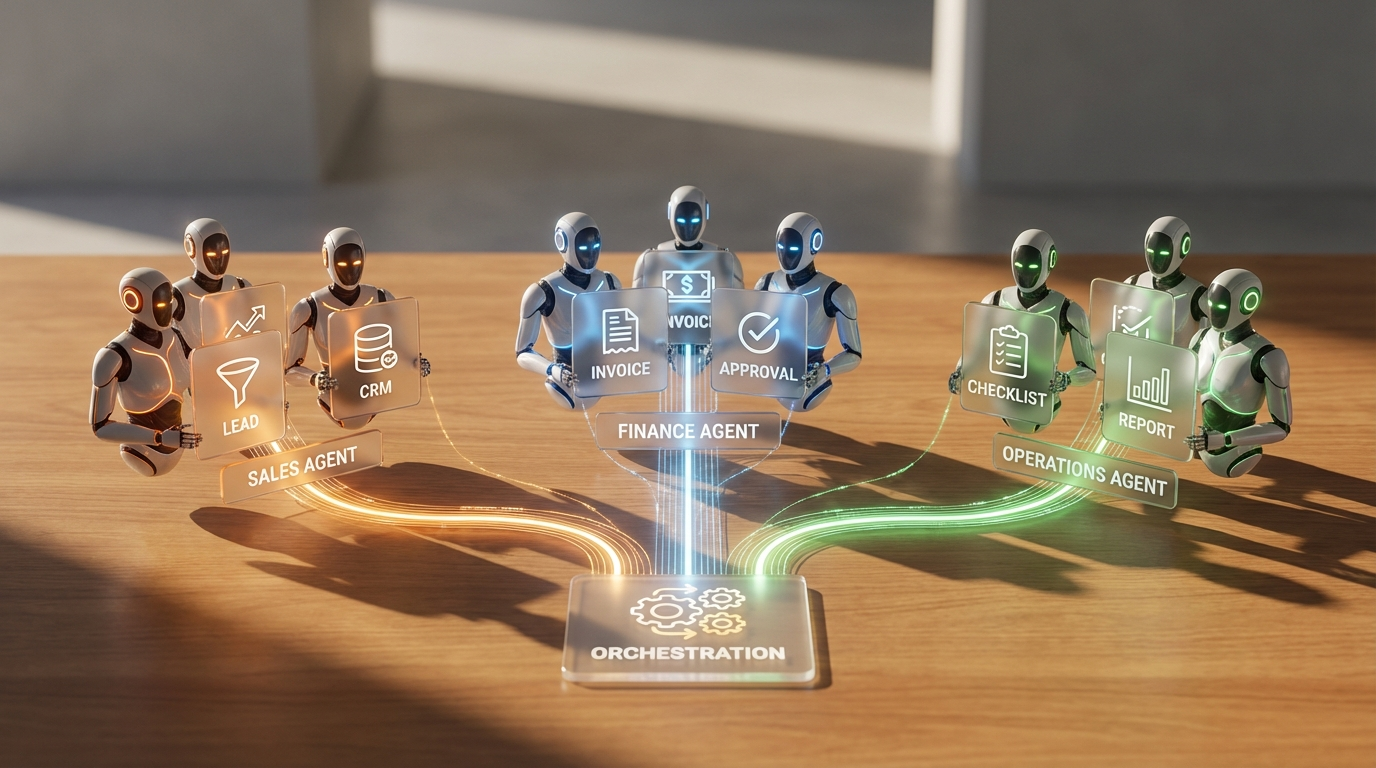
A few use cases are too complex for any one agent to handle efficiently. In such scenarios, organizations tend to adopt multi-agent systems in which multiple specialized agents work to attain a common goal. Each agent is responsible for a small area of activities, making the entire system easier to scale up and maintain.
Communication between agents may take place in common memory, messaging systems, orchestration frameworks, or by specialized agent-to-agent protocols. With this approach, several practical benefits are evident. Custom agents make systems more efficient: large workloads can be distributed across many parts, and failures are more isolated, without affecting the whole system. As AI systems become more sophisticated, multi-agent architectures are becoming an increasingly common design pattern.
Institutions require mechanisms to secure compliance with regulations while ensuring that the right actions can take place and that the operations are reliable. Typically, these safeguards include:
It’s not that this whole is about being completely self-controlled. Routine, low-risk actions can frequently run with minimal human intervention, whereas sensitive operations may need human input before action. Good governance guarantees that the agents stay useful and don’t put themselves at unnecessary risk.
AI agents are far more than language models connected to a few tools. The effectiveness of an AI agent depends on how well these pieces work together. In production environments, the surrounding architecture is often just as important as the model itself.
Customer support agents are probably the easiest use case to understand because the workflow is already repetitive:

Source: https://solsync.co/client-support-agents/
Klarna is one of the most cited examples here. Its AI assistant handled two-thirds of customer service chats in its first month and performed work comparable to hundreds of full-time agents. It worked across support flows, languages, customer context, and issue resolution.
Research agents, as the name implies, are built for working (finding, filtering, comparing, and summarizing) with information. They are useful when teams need answers from many sources.
A research agent can then access information from those sources to discover patterns that would take hours to bring to the surface. Instead of reading hundreds of support tickets in preparation for a planning meeting, a product manager might get a concise summary of the most frequently reported complaints and feature requests.
E-commerce agents work very near to revenue in comparison to many other AI systems. Shopify Sidekick provides a window into that trend. It’s built around what it means to operate an online store. It understands products, orders, inventory, and store operations.
On the customer side, an e-commerce agent might assist customers in locating the appropriate product or answer questions about shipping and returns. On the business side, it can spot inventory problems, raise the alarm on unusual sales patterns, or suggest actions based on store performance.
There is a subtle difference that is important. Instead of just making suggestions, the agent is actually working with live business data. That lets it react to what’s happening today.
Operations agents don’t receive very much attention, as customer-facing ones would do, but often they provide some of the clearest business value. Every business has processes that involve moving information between systems, checking documents, routing requests, or coordinating approvals. This is repetitive work, but it still consumes significant time.
Microsoft Copilot Studio signals a larger trend toward agents that act inside of business workflows rather than alongside them. Companies are more frequently utilizing AI to take up the administrative work that lies between teams and software systems. Picture a worker submitting a question via Slack.
An operations agent would be able to interpret this request to create the required ticket, alert the appropriate team, track progress automatically, etc. But the employee perceives a simple interaction, and the agent does the coordination behind the scenes.
Most organizations already have dashboards. What they often lack is the time and expertise required to probe each shift in performance.
Analytics agents help businesses better process increasing amounts of business data. It is more like an analyst than a reporting tool. If there’s a sudden drop in conversion rates, the agent has the ability to look at multiple data sources, search for unusual patterns, and recommend plausible explanations.
Teams do not begin with a spreadsheet but with a hypothesis. The best analytics agents go a step further. They are always watching metrics carefully and flagging issues before someone asks for a report.
We have seen a single-agent system as the most common AI agent architecture. Each agent is given a task, it is given context, executes tool calls, maintains memory, and generates the final output. A single-agent system is sufficient to fulfill many use cases (e.g., customer support).
From an engineering point of view, single-agent systems are easier to deploy and maintain. There will always be one reasoning loop, one state manager, one execution path. There are fewer dependencies and fewer failure points, so monitoring, debugging, and evaluation is easier. It is also why many enterprise AI agents begin as single-agent deployments and are extended into more sophisticated architectures.
Source: https://www.dima-ai.com/blog/agentic-ai-multi-agent-systems-autonomous-workflows-in-2026
The bottleneck becomes evident when the workflow expands to include multiple responsibilities. Multi-agent systems make this problem of handling workflows more manageable by creating separate parts for each workflow of the system. No single agent executes the entire process; multiple agents perform different duties.
That does not mean multi-agent systems are perfect. They require more planning and coordination. However, for larger organizations and more complex workflows, they are often a better fit than relying on a single agent to carry the entire workload.
The useful part of an agent comes from the infrastructure around the model: how it gets context, finds data, calls tools, follows workflows, and stays controllable in production.
MCP is especially worth highlighting in this section because it’s becoming a common integration layer for agents: the official docs define it as an open standard for connecting AI applications to external systems, and Anthropic introduced it as a way to build secure two-way connections between AI tools and data sources.
AI agents are most valuable when they are attached to a real workflow. As we mentioned, the customer support side is one of the simplest instances to find.
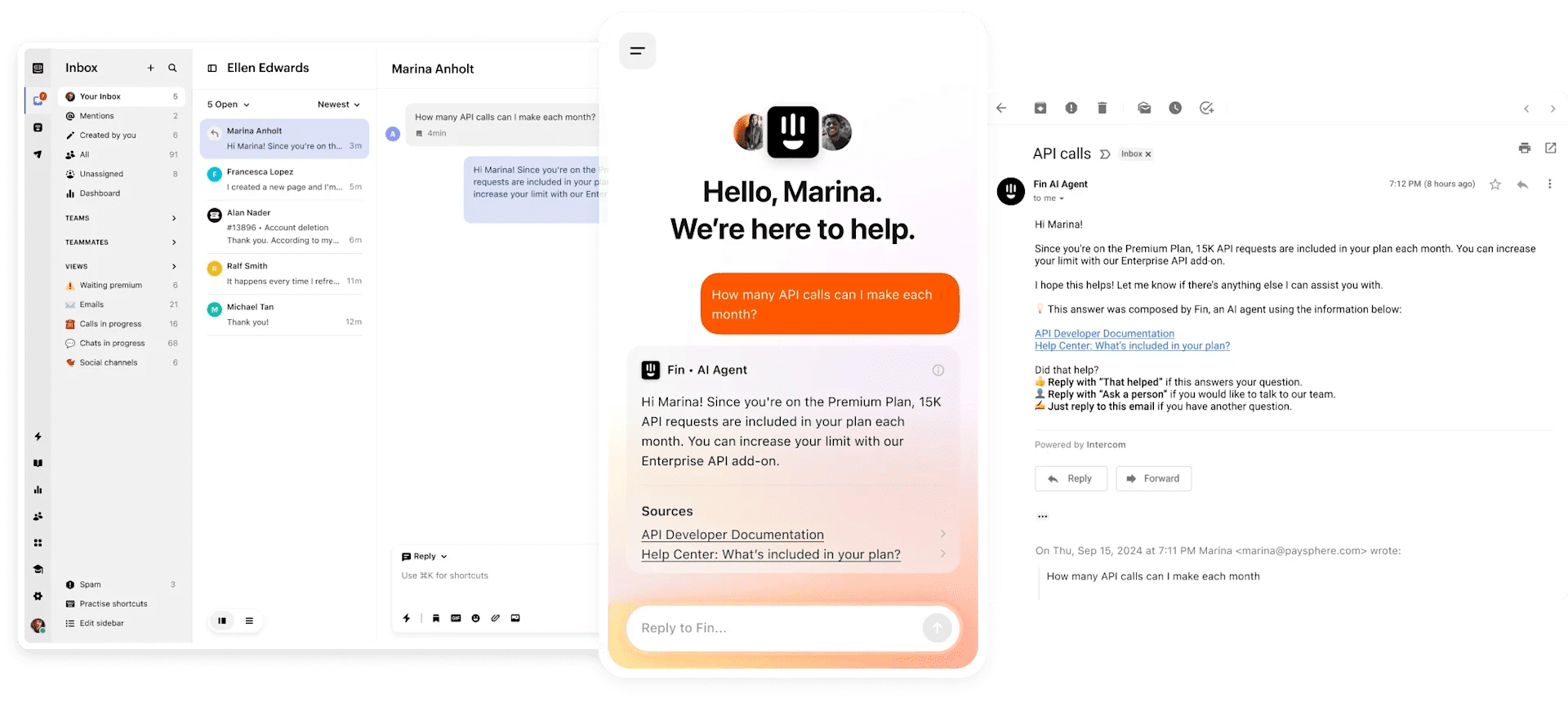
The Fin of Intercom is a prime example of this category. Intercom says Fin resolves more than 50% of customer conversations on average without human involvement. For this reason, a company processing 100,000 support tickets in a single month would mean 50,000 fewer tickets to human agents. Taking a handling cost of $5–$10 per ticket into account, the potential savings in this respect run from $250,000 to $500,000 per month. The benefits are not limited to cost reduction only. Quicker responses mean more satisfied customers, and the support team is free to tackle more complicated cases instead of repetitive requests.
Source: https://www.gptbots.ai/blog/intercom-fin-pricing
Amazon’s Rufus shows how AI agents are being applied in e-commerce. Rufus is designed to help shoppers discover products, compare options, answer purchase-related questions, and navigate large product catalogs using conversational interactions. It helps customers find relevant products based on intent and context.
Microsoft Copilot Studio is a good example of how enterprise platforms are moving toward autonomous AI agents combined with workflows. The idea is simple: agents handle reasoning and adaptability, while workflows provide structure and consistency.
For example, an internal operations agent could receive an employee request in Slack, classify it, check company policy, create a Jira or ServiceNow ticket, assign the correct owner, and notify the requester. In finance, a similar agent could extract invoice data, compare it with purchase orders, flag mismatches, and route exceptions to a human approver.
AI agents can reduce manual work, but they also bring a whole new class of risks. The more autonomous an agent is, the more it must be monitored.
Reliability is the first big challenge. LLMs possess probabilistic properties, and therefore, the same input leads to different outputs. This is acceptable for drafting text, but dangerous for operational workflow work. Production agents require validation layers, confidence filters, retries, fallback logic, and human approval for delicate efforts. That’s not meant to make the model “perfect.” To make the system safe in the face of uncertainty about the model.
Data access is another risk. Enterprise AI agents frequently require customer logs, internal documents, product data, financial data, or employee information to do relevant work. That is, permissions should not be treated as an afterthought. The agent should return only the information that it is permitted to view, only to the desired user, and store only data that the business really needs.
Tool use also leads to points of failure. APIs can return data that is stale, time out, silently fail, or change response formats. The failure will occur if the agent does not handle them correctly; this may just lead to an ongoing workflow that could contain bad assumptions. A great implementation needs typed tool schemas, input validation, error handling, rate-limit management, idempotency checks, and defined rollback paths. In other words, the agent should not break production because one API response turned up strange.
Hallucinations remain an actual problem, particularly if the agent is in an incomplete context. Retrieval-augmented generation is helpful, but it doesn’t solve the problem on its own. Before action is taken on relevant information, the system still requires source grounding, policy checks, and output validation.
When using multi-agent systems, increased complexity in coordination increases the risk involved. When multiple agents do tasks of passing between one another, failures can be even harder to trace. One agent gets weak context, another produces output there, a third validates the wrong thing, and it seems as though the outcome was successful. Multi-agent systems require good orchestration, shared state management, and observability at all steps.
The practical solution is not through the exclusion of those AI agents. It’s to design them like serious software. Start with scoped workflows. Limit permissions. Keep humans in the loop for high-risk actions. Log calls for and decisions made by tools or models. Test agent behaviors before every release. Post-deployment, monitor performance in the wild. Agents can be powerful, but only when autonomy comes with control.
AI agent development cost depends less on the “agent” label and more on how much real work the system needs to perform. A simple internal assistant is one budget. A production agent connected to business systems and workflows is a very different project.
Use this checklist to understand what affects the price:
In fact, there is no one-size-fits-all pricing strategy for AI agent development, as every business has different processes. Evaluating the workflow with respect to the required level of automation and designing the appropriate architecture will go a long way in determining the implementation cost.
That is where Quantum Core can provide this help. We collaborate with organizations to find meaningful use cases, define the right scope, design the technical architecture, connect agents to real business tools, and deploy solutions that deliver measurable value beyond demos. For AI agent development services for support, operations, analytics, sales, and internal automation, you can reach out to Quantum Core to discuss your project or to develop a solution designed for your business.
Contact us today!


Lorem ipsum dolor sit amet, consectetur adipiscing elit. Suspendisse varius enim in eros elementum tristique. Duis cursus, mi quis viverra ornare, eros dolor interdum nulla, ut commodo diam libero vitae erat. Aenean faucibus nibh et justo cursus id rutrum lorem imperdiet. Nunc ut sem vitae risus tristique posuere. uis cursus, mi quis viverra ornare, eros dolor interdum nulla, ut commodo diam libero vitae erat. Aenean faucibus nibh et justo cursus id rutrum lorem imperdiet. Nunc ut sem vitae risus tristique posuere.
Reply