

AI Development
Best Tech Stack for AI Applications in 2026
Explore the best AI tech stack for LLM applications, AI agents, RAG systems, and enterprise AI infrastructure.
September 22, 2026
•
13
min read

A good AI stack should make experimentation cheap and avoid making production fragile. As AI products evolve, their models and retrieval mechanisms rarely stay the same. A modular architecture makes it easier to introduce changes without disrupting the rest of the system.
So what does your stack need? The core criteria are fairly practical:

Source: https://vocal.media/01/why-you-should-learn-full-stack-development-in-2025
Hence, those factors matter more than any particular framework name. A stack built around the latest tools can age badly in months, while an AI app architecture with clean boundaries can absorb new models and agent patterns with much less friction.
For a production LLM tech stack, four providers deserve serious consideration in 2026.
OpenAI’s current production story centers on the GPT-6 family, with GPT-6.1 Sol as its newest general-purpose model for coding and professional workloads. It sits below GPT-6 Astra in raw capability, but OpenAI positions it much closer to Astra-level performance than the pricing suggests: standard API pricing starts at $2 per million input tokens and $10 per million output tokens for prompts up to 272K input tokens.
Source: https://qz.com/openai-chatgpt-gpt-6-intelligent-ui-interactive-visuals-100826
GPT-6.1 Sol works through the Responses API. Thanks to that reasoning, tool calls, state, and external actions can live inside the same request flow. It also supports OpenAI’s beta multi-agent mode, which allows one model call to delegate work to subagents.
The practical reason to choose GPT-6.1 Sol is architectural leverage. If the application already depends on tool execution, computer use, persistent reasoning flows, or agent delegation, OpenAI provides a fairly complete runtime around the model.
Claude becomes especially interesting once an agent starts carrying substantial state across long tasks. Sonnet 5.5 offers:
Opus 5.5 keeps the same context envelope but allocates more model capacity to difficult reasoning workloads.

Source: https://www.reuters.com/business/finance/anthropic-warns-ai-may-pose-existential-risks-humanity-ipo-filing-2026-09-29/
Claude treats reasoning state as part of the execution model. In Sonnet 5.5, thinking blocks can persist through tool-driven conversations, which is useful for autonomous coding agents or research loops where dozens of intermediate operations may accumulate before the final response.
Claude deserves particular attention when context management forms part of the application logic rather than a simple prompt-size problem.
Gemini 4 Argon is the newest and most capable model of the Gemini family, released on September 30, 2026 by Google DeepMind.
Source: https://webscraft.org/blog/google-gemini-povniy-gayd-mozhlivosti-ta-instruktsiya
A voice assistant with visual context or an agent that has to reason over mixed media creates orchestration overhead when every modality depends on a different vendor and API contract. Keeping those workloads in the Gemini ecosystem can reduce the integration surface and make state transfer between inference steps simpler.
Gemini 4 Argon therefore makes the strongest case where multimodality and high-end reasoning overlap. For simpler inference, routing every request through the flagship model would usually waste both latency budget and compute spend.
Mistral Large 4 changes the provider’s position in the LLM tech stack quite a bit. Mistral now has a frontier-scale MoE system with roughly 1.05 trillion total parameters and about 49 billion active parameters per token.
The MoE design is especially relevant from an infrastructure perspective. Only part of the parameter space participates in each token computation, so raw parameter count says relatively little about actual inference cost. Mistral also exposes structured outputs, function calling, batching, document Q&A, agents, and conversation APIs around Large 4, which makes it much easier to place inside a production stack.
Mistral becomes especially interesting for teams that care about infrastructure ownership. Large 4 is available through the hosted API today, while the upcoming weight release creates a path toward self-hosted inference once the hardware economics justify it.
For most AI development workloads in 2026, vector databases Pinecone, Qdrant, Weaviate, Milvus, and pgvector cover very different parts of the design space.
Pinecone is still the first option when the team wants vector search as managed infrastructure. Its serverless architecture abstracts shard placement and capacity planning, which makes it attractive for SaaS products where traffic changes real fast.
Pinecone works well when vector retrieval is important to the product but irrelevant as an infrastructure competency. Once teams need low-level control over index layout or placement, other databases become more interesting.
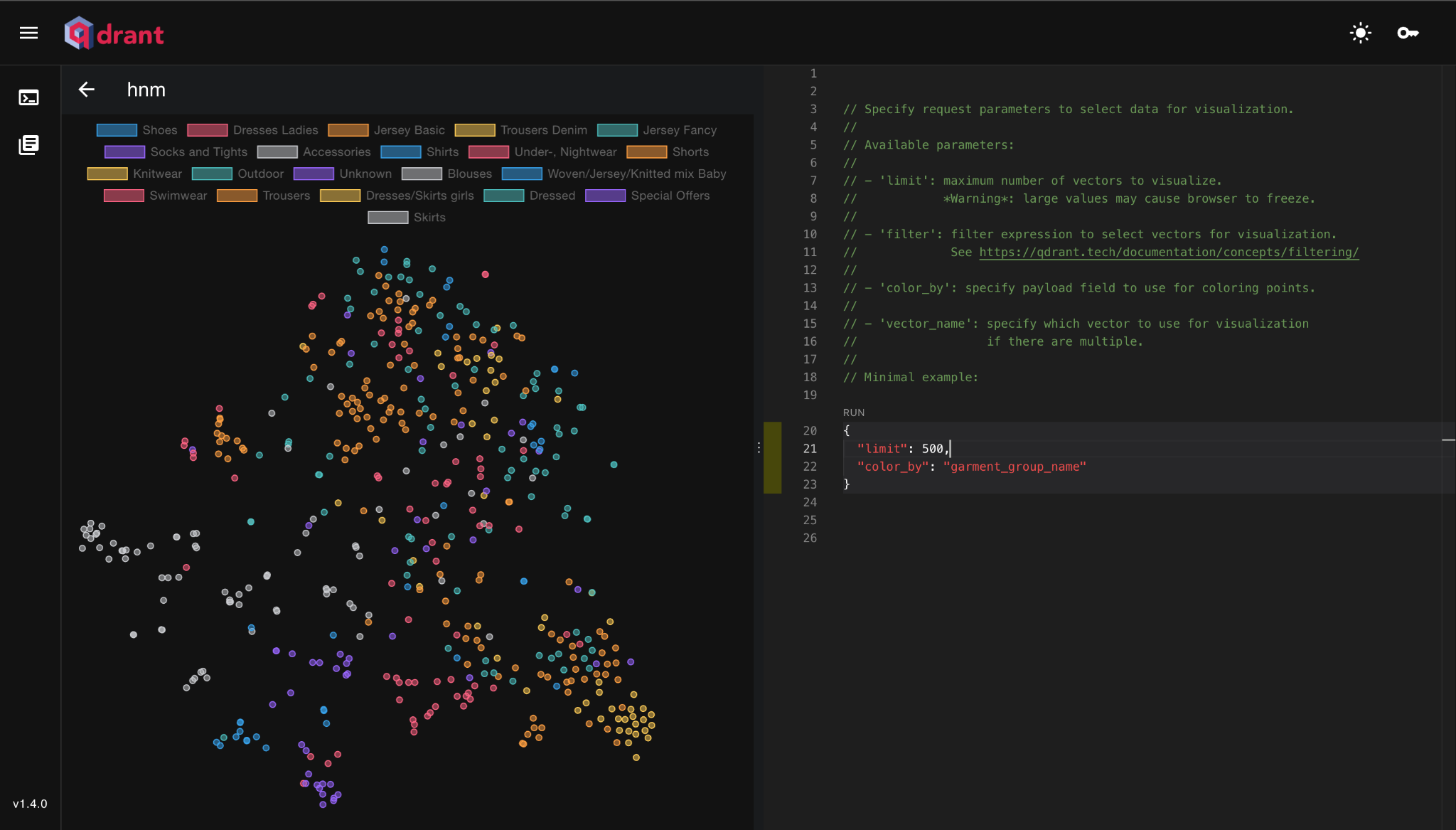
Qdrant becomes much more compelling once retrieval stops being a single dense-vector query. Its Query API supports multi-stage pipelines through prefetch, and dense retrieval, sparse retrieval, reranking, and nested candidate-generation steps can live in the database query itself rather than in a separate orchestration service.
Source: https://qdrant.tech/blog/web-ui-gsoc/
That is very important in modern RAG, as semantic similarity alone is rarely enough. Qdrant stores dense and sparse representations on the same point, making hybrid retrieval much cleaner than maintaining parallel search systems.
For an AI development stack where retrieval quality matters more than “just get me nearest neighbors,” Qdrant is one of the strongest defaults.
Weaviate treats vector search more like a complete retrieval engine. Vector indexes sit beside inverted indexes, so BM25F and semantic retrieval can run together through configurable fusion. Its hybrid search executes both paths and combines the result scores.
It also handles multiple vector spaces per object. That becomes useful in multimodal search or domain-specific retrieval where collapsing everything into one embedding loses signal.
Weaviate is especially strong when search itself becomes a product feature. Its multi-tenancy model also fits B2B AI products well because tenant data can remain physically isolated at the shard level.
Milvus is one way to look at when vector scale starts to impact infrastructure design. Version 3.0 took the system much further toward larger-scale distributed deployments, with Storage V3, external collections, snapshot support, and continued work on search path performance. Version 3.0.2 specifically targeted contention in filtered search, grouping and index construction.
Milvus belongs in an AI stack when vector search is large enough to justify dedicated infrastructure. For a small RAG service with a few million embeddings, it can easily be more machinery than the application needs.
pgvector is the one that people tend to underestimate because it appears to be so simple: vectors reside in PostgreSQL along with the other data in the application. That simplicity is exactly the advantage. If the corpus already maps cleanly to relational entities, keeping metadata filters, transactions, joins and embeddings inside one database avoids a whole synchronization layer.

Source: https://blog.stackademic.com/pgvector-vs-pinecone-the-prototype-was-easy-filtering-chose-the-production-winner-a78690e97101
pgvector supports approximate nearest-neighbor indexes such as HNSW and IVFFlat, but still inherits PostgreSQL's architecture and operational model. For moderate vector workloads, that can be an advantage; once vector retrieval becomes its own high-throughput subsystem, a dedicated engine usually offers more headroom.
For many teams, pgvector is actually the right starting point for AI development. Adding a dedicated vector database before PostgreSQL becomes the bottleneck often creates more architecture than value.
Once an application moves beyond one prompt and one response, orchestration becomes part of the AI backend architecture. And here we’ll cover 3 of the most popular options.
If you want direct control over execution, LangGraph is maybe the best fit. Its core abstraction is a stateful graph where deterministic code and model-driven decisions can run on the same execution path. It’s useful in systems where an LLM is able to decide what to do next, but engineers need to be able to set hard boundaries around retries, branching, persistence, or human approval. LangGraph is low-level; LangChain's own docs say that it is an orchestration runtime, not a high-level agent abstraction.
The persistence model is especially relevant for production agents. The checkpoints capture the state of the graph at each execution step. The process can resume after the interruption in the execution stage. Different stores can hold longer memory for each thread and hence for different threads.
LangGraph belongs in an AI stack when you care more about predictable execution semantics than getting an agent running in twenty lines.
LlamaIndex, as the one of the most mentioned LangChain alternatives, makes more sense when orchestration grows out of retrieval. Its Workflows layer employs an event-driven model, and steps react to typed events alternatively to going through a linear chain.
Source: https://github.com/run-llama
A typical LlamaIndex application can start with RAG and grow into something much more agentic without leaving the same ecosystem. The framework already has abstractions for tool use, query planning, sub-questions, multi-agent workflows, and custom event-driven execution.
For AI development around knowledge systems, LlamaIndex can remove a lot of glue code because retrieval and orchestration already share the same abstractions.
For those teams that already exist in enterprise infrastructure, Microsoft Agent Framework is more relevant than AutoGen in 2026. AutoGen is now in maintenance mode, whereas Agent Framework 1.0 is now Microsoft’s production successor and combines the ideas from AutoGen with Semantic Kernel enterprise tools.
Its scope is wide. A developer can start with just one agent, move on to graph-based workflows, or coordinate multiple agents via sequential, concurrent, handoff, group chat and Magnetic orchestration. Microsoft stabilized those orchestration APIs across Python and .NET in 2026.
The framework becomes especially attractive when orchestration has to integrate with the rest of an enterprise platform rather than live as an isolated Python service. Microsoft explicitly supports multi-provider models and self-hosted or cloud-hosted deployment patterns, so the agent layer does not have to stay locked to one model vendor.
The backend of an AI application has a different workload profile from a conventional CRUD service. Building the AI development stack around ordinary request-response assumptions usually creates problems once concurrency increases.
A production backend therefore needs several separate execution paths.
Python remains the natural backend language for many AI products because most model SDKs and ML tooling arrive there first. FastAPI fits that environment particularly well.
That does not mean every piece of model work must be inside an async endpoint. Calling a hosted LLM over HTTP is mostly I/O-based and can work well for asynchronous execution. Local embedding inference, parsing a 500-page PDF, or CPU-intensive preprocessing in the same event loop is a different story, so these jobs should be done in workers or dedicated inference services.
A typical FastAPI service might have:
Node.js is still appealing when the AI feature resides in an existing TypeScript product. NestJS gives larger teams dependency injection, modules, guards, interceptors, and strong application structure without introducing Python purely to call an LLM API. Go becomes interesting further down the latency and concurrency curve.
Source: https://www.rudderstack.com/blog/api-integration/
The language choice should follow where the computation is. If most inference happens through remote APIs, the backend does very little ML itself; TypeScript or Go can be perfectly reasonable. Python becomes much harder to avoid once the service owns local models.
An HTTP request should rarely remain responsible for a task whose lifetime can reach minutes.
Document ingestion is an obvious example. Uploading a file may trigger parsing, chunk generation, metadata extraction, embedding inference, vector indexing, and perhaps a summarization pass. Keeping that chain attached to one web process creates ugly timeout semantics and makes retries dangerous.
Push the job onto a queue instead.
Celery remains useful for conventional Python worker pools. Cloud-native stacks often use SQS, Pub/Sub, or Azure Service Bus directly. Kafka becomes relevant once the system needs high-volume event streams. Temporal is worth considering when jobs contain durable multi-step state and must survive failures halfway through execution.
LLM requests create unusually fragmented state. Trying to store every one of them access patterns in PostgreSQL puts unnecessary pressure on the main database.
Redis is a common fit for the hot path. Useful Redis state includes:
Semantic caching deserves special care. Caching hash(prompt) exactly is not useful because very small changes in prompt cause different keys to be used. Embedding the request and fetching sufficiently similar previous queries can save considerably more model spend, but only if you can reuse the response.
Persistent business state still belongs in a durable database like PostgreSQL. Redis should speed up the system; the product should rarely have the only copy of information it cannot afford to lose.
A GPU is a scarce execution resource, and an ordinary Python web server has no idea how to schedule one efficiently. That responsibility belongs to a dedicated inference runtime.
vLLM is one of the obvious choices for open-weight models. It exposes an OpenAI-compatible HTTP server, which is useful because application code can often switch between hosted OpenAI-style endpoints and internal inference without replacing the entire client abstraction.
For higher-volume systems, model routing becomes another layer. A cheap model can handle extraction or classification while a frontier model receives difficult reasoning requests. Self-hosted models may absorb predictable high-volume workloads, with hosted APIs acting as overflow or specialist routes.
Containers matter in AI infrastructure because runtime drift is brutal. By building dependencies into separate images, each workload can have its own release cycle and hardware assumptions.
Kubernetes becomes useful when scheduling decisions make more than CPU and RAM. A single cluster may have cheap CPU nodes for parsers, L4-class GPUs for embeddings, and larger accelerators for heavyweight generation. It also helps when models themselves become deployment units.
Source: https://cloud.folio3.com/blog/benefits-of-kubernetes-for-businesses/
The CPU utilization tells us very little about an LLM server whose real limitations are:
If requests are running slow and the API tier is scaling, then there will still be callers for the same GPU pool. The signal really is at the inference layer.
For smaller products, the complexity is usually unnecessary. Cloud Run, ECS, Modal, Runpod, or similar managed runtimes can handle a large amount of AI traffic before cluster ownership becomes worthwhile. Kubernetes is in place when GPU placement, heterogeneous workloads, or multi-model serving have already become operational problems.
OpenTelemetry has dedicated GenAI semantic conventions for recording model operations and can capture attributes such as model/provider information, token counts, tool interactions, and retrieval activity. That makes it possible to connect ordinary distributed traces with inference-specific behavior rather than maintaining a completely separate debugging model for AI requests.
Useful production telemetry goes beyond total latency:
Be careful with prompt-level telemetry, though. Prompt and completion payloads can contain customer data, API responses, or proprietary documents, so full-text logging should be opt-in and aggressively redacted.
AI frontends have to treat incomplete states as usual. Response streams token by token, tool calls can interrupt generation, and one user action may keep mutating the interface long after the initial request is made. For most products, React + Next.js + TypeScript is a good baseline because the component model can handle partial rendering well, while server components and streaming boundaries help separate stable data from live model output.
Once the interface has to deal with model events besides plain JSON, it is useful to have a client layer. The Vercel AI SDK can normalize streamed messages; TanStack Query or a similar cache layer should handle durable server-owned resources. Keep transient UI state separate from conversation history and agent checkpoints; mixing them in one client store makes streamed updates and refetches much more difficult to reason about.
Transport depends on the interaction pattern:
Tool-heavy interfaces benefit from explicit state machines like requested → awaiting_approval → executing → succeeded. The same principle applies to generated UI: charts, citations, forms and approval cards should come from validated schemas, then map to deterministic components.
AI observability also has to go beyond uptime and HTTP latency. The useful stack combines infrastructure telemetry with model-level traces.

Source: https://extendedlearning.ubc.ca/areas-study/artificial-intelligence-ai
For most teams, OpenTelemetry should sit underneath the stack as the common tracing layer. Tools like LangSmith, Arize Phoenix, Helicone, and Weights & Biases Weave add AI-specific visibility into prompts, retrieved context, tool execution, latency, token usage, and eval results.
The key metrics are usually time to first token, total generation latency, retrieval latency, tool-call duration, token volume, cache hit rate, provider errors, and cost per successful task.
AI deployment has two separate release problems: shipping application code and shipping model behavior. A backend revision can pass ordinary integration tests while a new model changes something. For that reason, the AI development stack should version model IDs, prompts, routing rules, and evaluation configs alongside code. Kubernetes remains common for self-hosted inference.
Canary and shadow deployments are usually more useful for model changes. A canary sends a small share of real traffic to the new configuration and promotes it. Shadow deployment is safer for larger behavioral changes.
A practical production strategy usually looks like:
The promotion gate should include AI-specific signals as well as infrastructure health.
AI Chatbot
RAG / Enterprise Search
AI Coding Assistant
Voice Agent
Multimodal AI Product
Multi-Agent System
Choosing an AI stack is ultimately an architecture decision. The right combination depends on:
If those decisions are still open, AI architecture consulting can help define the stack before implementation starts and avoid expensive rewrites later. For teams ready to move into production, an experienced AI product development partner, QuantumCore, can take the same architecture through every stage of production.
LangChain, LlamaIndex, and lightweight custom TypeScript/Python async functions combined with direct API function-calling.
Many teams are shifting away from monolithic, black-box agent frameworks in favor of modular, transparent state machines (like LangGraph) or custom programmatic loops.
Only when scaling to tens of millions of high-dimensional vectors where distributed searching, sub-millisecond multi-tenant isolation, or specialized clustering (e.g., Milvus, Qdrant, Pinecone) becomes mandatory.
It’s a good strategy starting with simple PaaS options or Docker containers on straightforward cloud virtual private servers (VPS) to avoid unnecessary operational overhead.


Lorem ipsum dolor sit amet, consectetur adipiscing elit. Suspendisse varius enim in eros elementum tristique. Duis cursus, mi quis viverra ornare, eros dolor interdum nulla, ut commodo diam libero vitae erat. Aenean faucibus nibh et justo cursus id rutrum lorem imperdiet. Nunc ut sem vitae risus tristique posuere. uis cursus, mi quis viverra ornare, eros dolor interdum nulla, ut commodo diam libero vitae erat. Aenean faucibus nibh et justo cursus id rutrum lorem imperdiet. Nunc ut sem vitae risus tristique posuere.
Reply